
UN, WEF Float Using Iran War to ‘Shape Economies,’ Want Shortages To Drive ‘Progress’
The “Great Reset” playbook—never let a crisis go to waste.

My work is always free. If you can, consider supporting me for just $5 a month.
As the Middle East war destabilizes global energy markets, driving supply shocks and price volatility, the United Nations and World Economic Forum are not simply responding to the crisis.
They are using it.
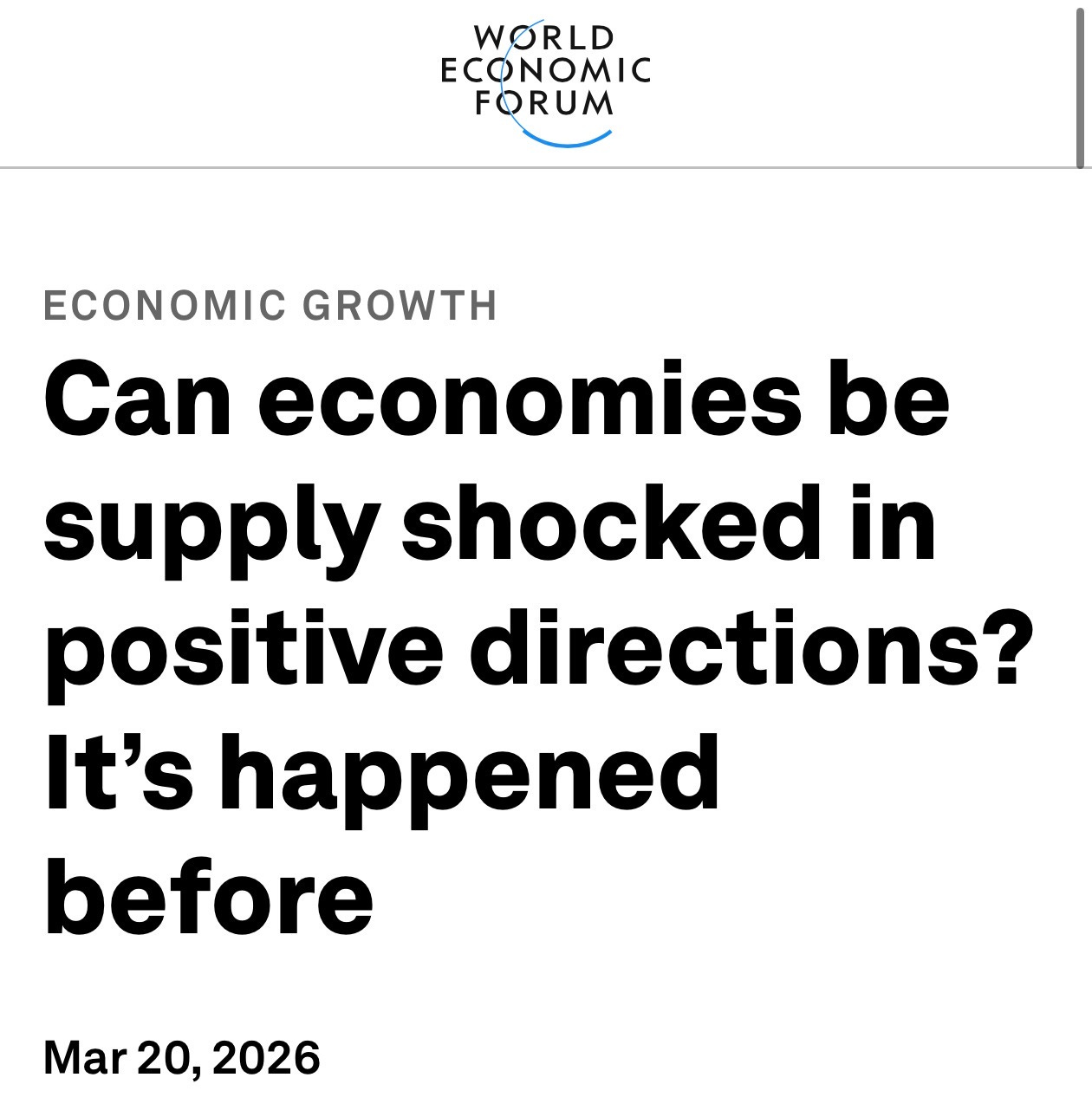
In a March WEF article titled “UN chief says Middle East conflict should accelerate shift to renewables” the message is not subtle: the war should be leveraged to speed up the phaseout of fossil fuels.
That framing comes directly from UN climate chief Simon Stiell, who told Reuters:
“If there was ever a moment to accelerate that energy transition, breaking dependencies which have shackled economies, this is the time.”
Not eventually. Not after stability returns.
Right now.
“Those risks are abundantly clear right now and are burning at everyone’s feet.”
In other words, the crisis itself is the argument
.
And when governments—facing immediate economic pressure—suggest easing climate rules to protect industries and consumers, Stiell’s response is not caution. It’s escalation:
weakening climate policies would be “completely delusional.”
So even as war threatens global supply chains and households brace for higher energy costs, the position being elevated by the WEF is clear: push harder.
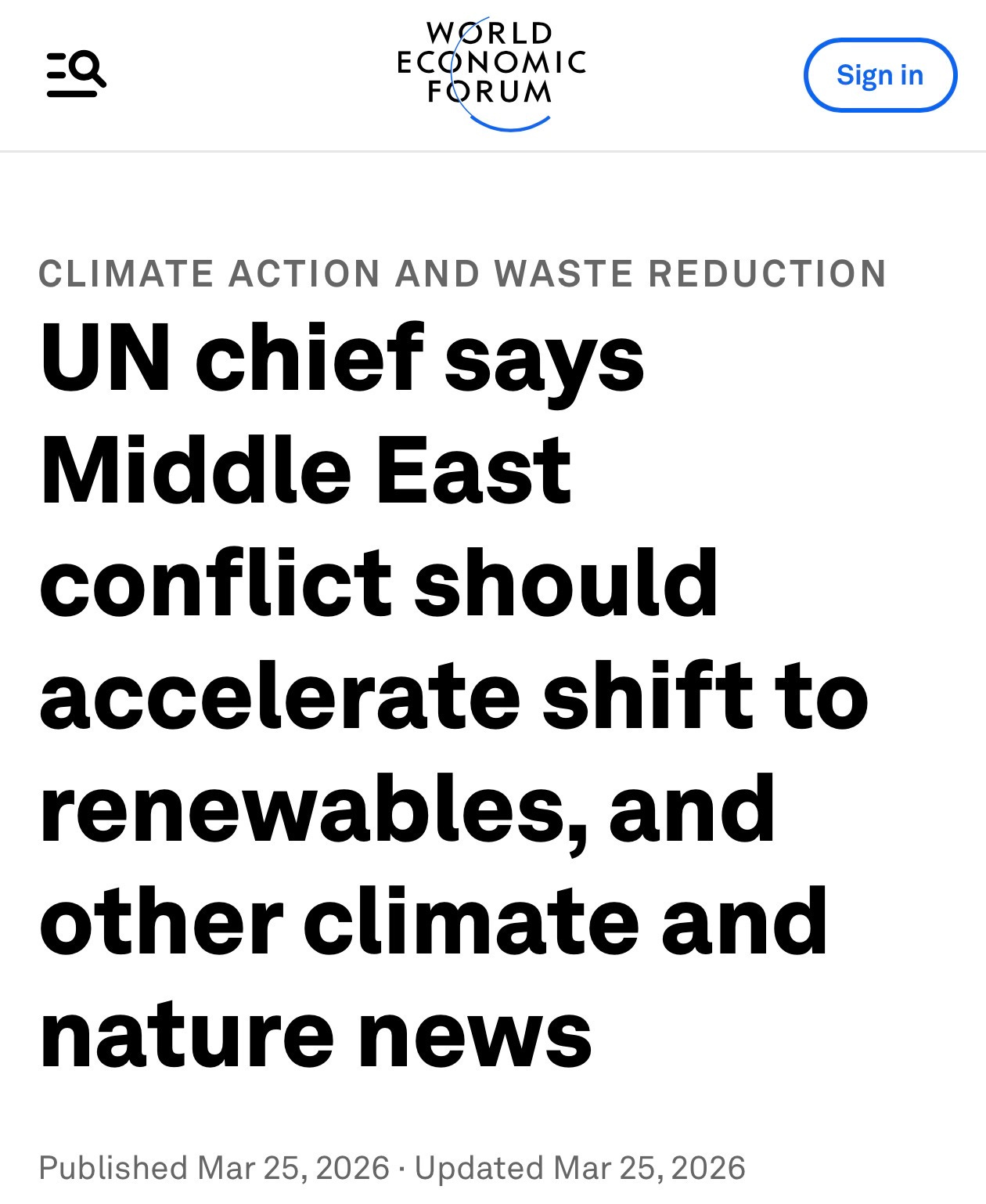
But the real tell comes from a second WEF article, published just days earlier, titled “Can economies be supply shocked in positive directions? It’s happened before.”
This is not about reacting to the war. It’s about explaining why crises like this are useful.
“History shows that these periods tend to nudge economies in new directions – sometimes for the better.”
The piece walks through how past shocks—especially the 1970s oil crisis—were used to restructure entire economies: energy systems redesigned, consumption patterns altered, governments imposing changes that would have been politically impossible under normal conditions
.
Then, almost casually, it acknowledges how this sounds:
“There is something strange about zeroing in on potential positives during a time of war and scarcity.”
Strange, yes.
But necessary—according to the logic that follows.
“History demonstrates that we can adapt, sometimes in ways that actually push economies forward.”
And then the line that makes the strategy explicit:
“Difficult moments are when the heaviest lifting can be done on shaping economies… Progress is a frequent result.”
That is not crisis management.
That is crisis exploitation.
Put both WEF pieces together and the framework becomes unmistakable:
The first—“UN chief says Middle East conflict should accelerate shift to renewables…”—uses the current war to argue for immediate acceleration of the energy transition.
The second—“Can economies be supply shocked in positive directions?”—explains why crises like this are ideal: because disruption lowers resistance and creates the political space to force through sweeping structural change.
The solution, conveniently, is the very agenda that struggled to gain traction before the crisis.
What was politically difficult last year becomes “urgent” today.
And the most revealing part is that they are not hiding it. They are writing it down, publishing it, and promoting it.
Crises “nudge economies.”
War creates “opportunities.”
“Difficult moments” are when you reshape everything.
Is that the same UN whose 'peacekeeping' troops routinely rape and pillage in the very areas they're sent to protect?
Asking for a friend.
All the while Europeans can't afford to heat their homes or buy fuel for their autos, the power grid is maxed out and they can't charge the electric vehicles and factories can't get the power to operate, the Brilliant WEF and UN want to switch to even more "renewables" = Turbines that only work when it is windy, solar panels bought from China that only generate electricity when the sun shines and does it best in the southern countries. Battery storage that relies on exotic elements that need to be mined and imported. Good Plan - NOT! Meanwhile Europe can't even really supply military assistance to the Iran war until the war is over. Funny how none of this "renewable" sources needs be done by China, who is still building coal plants without scrubbers. Yet they manufacture the renewables that they sell to the West.