
“Your vote may be the one that flips (or holds) a critical seat.”
That is the pitch a Democratic-aligned political group is making to high-school students deciding where to go to college.
MoveIndigo’s college guide asks prospective students to weigh the political consequences of their college choice alongside academics, affordability and campus culture. Its list contains 28 institutions, including Michigan State, Lehigh, Lafayette and the University of California, Merced.
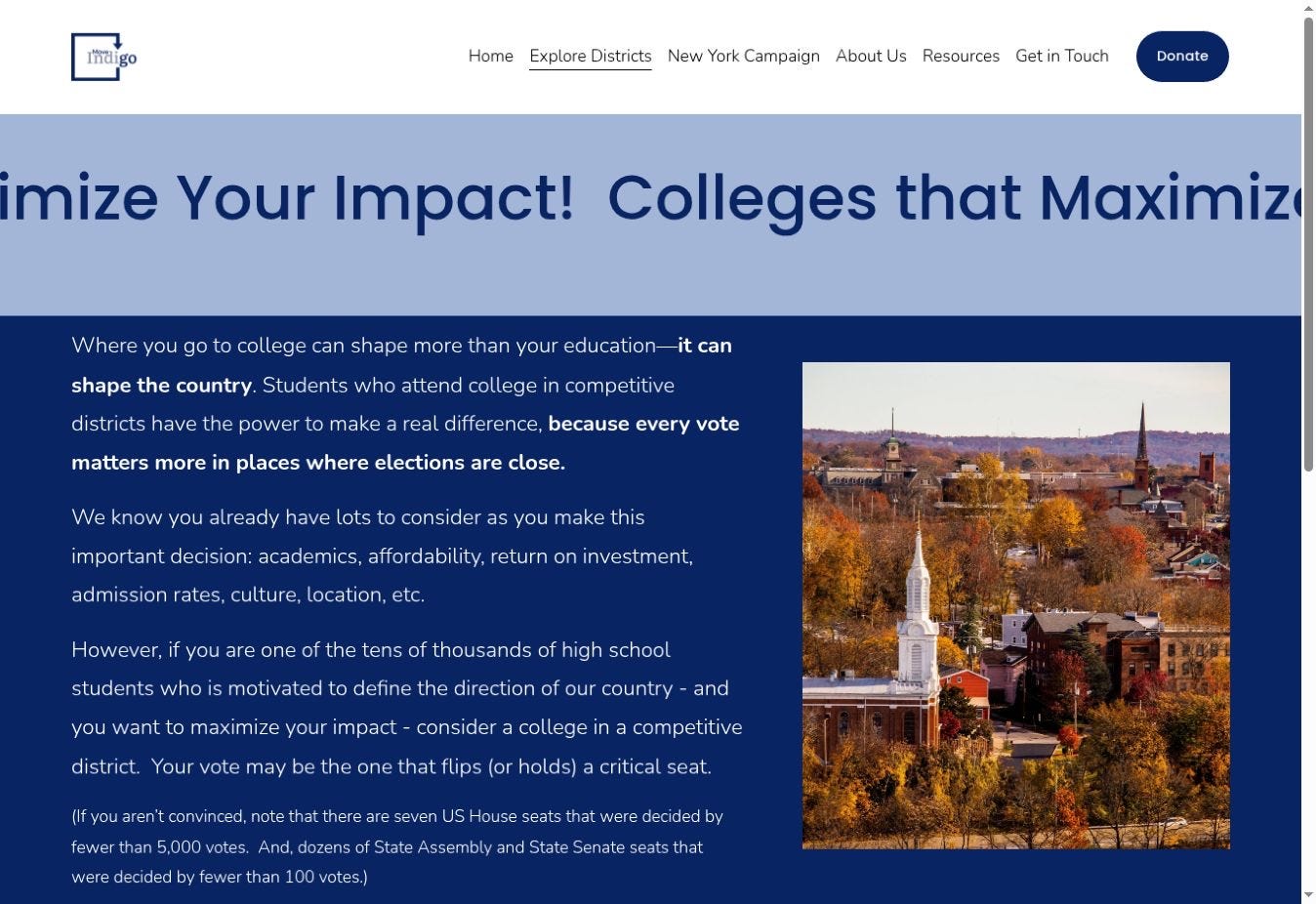
The full list of recommended colleges, along with the congressional districts MoveIndigo assigns them, appears in the appendix at the end of this article.
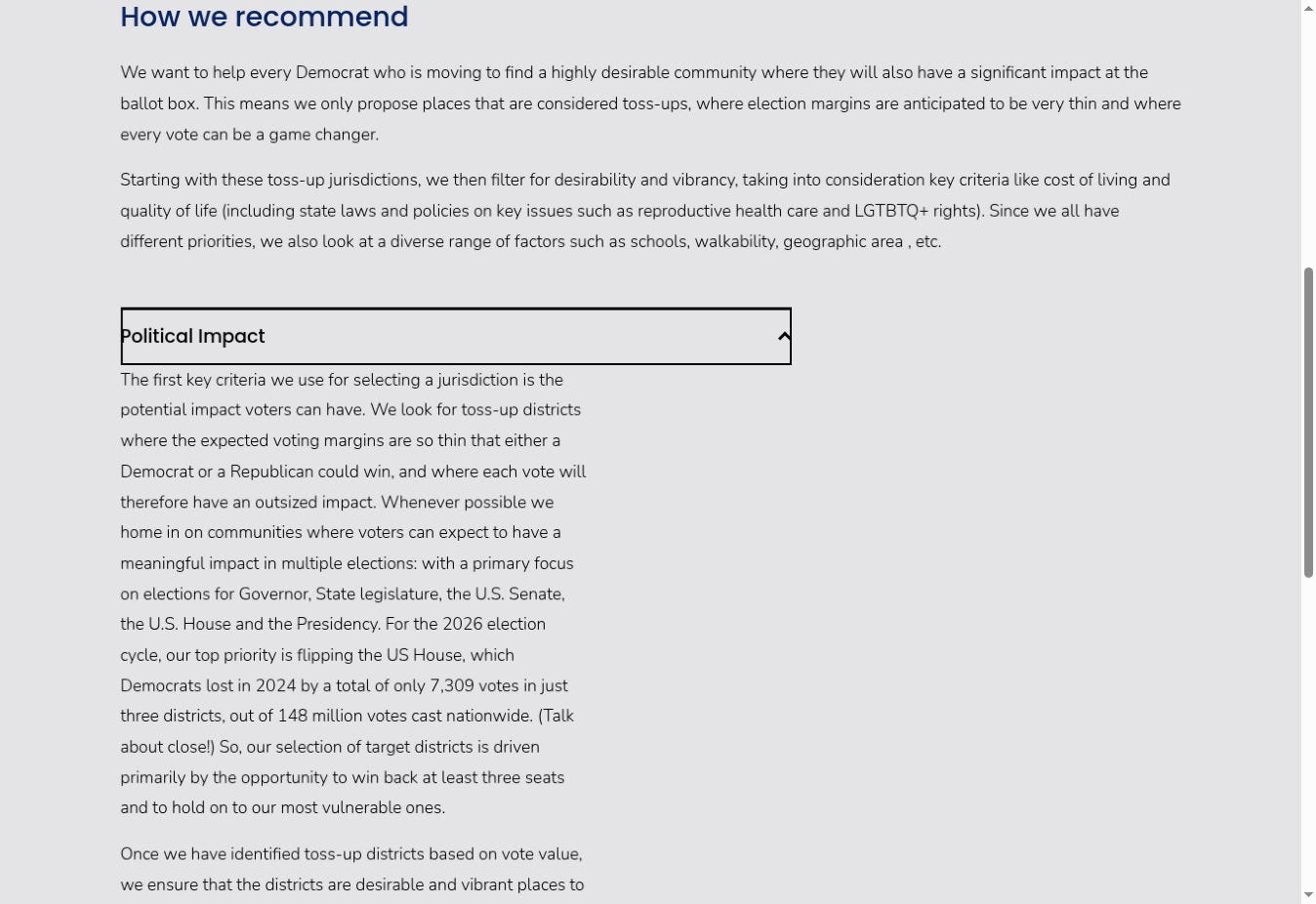
The organization has a specific electoral objective. Its 2026 strategy states:
“our top priority is flipping the US House”
The group behind the college pitch also received $59,150 from the Sixteen Thirty Fund, according to the fund’s 2024 tax return. The filing identifies Move Indigo Inc. by name and tax ID, although it does not earmark the grant for the college initiative.
For families, college selection means tuition bills, academic programs and a place their children might spend four years. MoveIndigo is asking them to add control of elected office to that decision.
A college list with congressional districts attached
MoveIndigo pairs its college recommendations with congressional-district labels. Michigan State is listed with MI-07. Lehigh and Lafayette appear with PA-07. UC Merced is paired with CA-13.
The presentation combines familiar college-search material with political geography: campus images, links to college profiles and the district in which the group wants prospective students to consider their influence.
Its broader relocation strategy begins with electoral competitiveness, then filters communities for economic and lifestyle considerations. The organization says it seeks Democrats who are already planning to move and helps them identify places where their votes could have greater consequences.
College-bound students fit that premise. They are already considering a move. MoveIndigo wants the destination to carry political weight.
Its ActBlue fundraising page extends the ambition beyond one election:
“flip the House in 2026 and turn the map blue by 2030.”
Taking the pitch to student audiences
MoveIndigo has promoted the guide outside its own website.
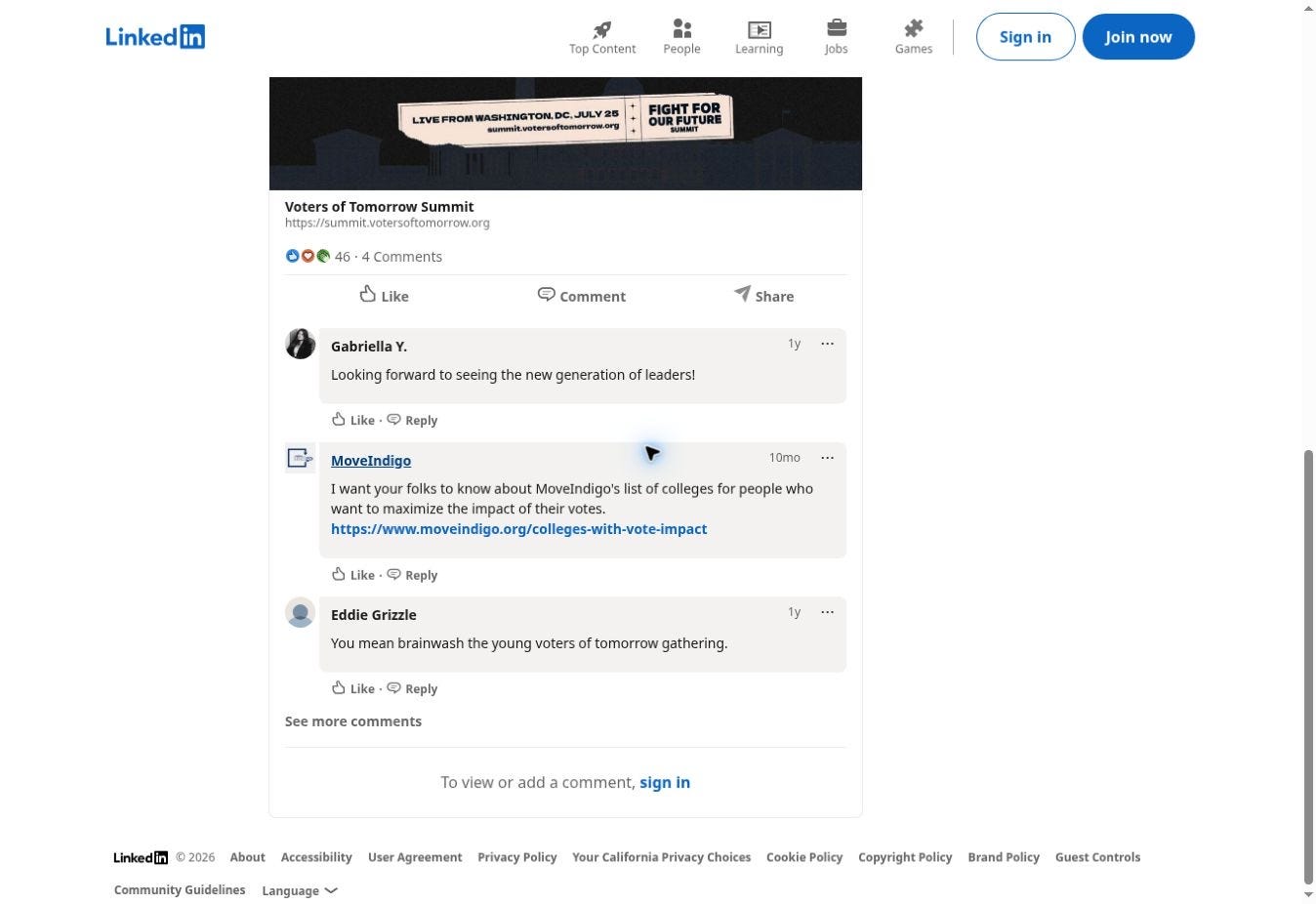
Beneath a Voters of Tomorrow post advertising its 2025 summit, the organization posted a link to the college list, writing:
“I want your folks to know about MoveIndigo’s list of colleges”
On its own LinkedIn page, MoveIndigo presented the list as an alternative consideration to conventional college rankings. The post used hashtags for the classes of 2026 and 2030, along with college decisions.
The group also addressed students beneath an NYU voter-registration video, urging them to compare the electoral significance of registering at home versus in New York City. That comment linked to tools for comparing states and congressional districts.
These are public outreach efforts by MoveIndigo. They do not establish that NYU or Voters of Tomorrow endorsed the college campaign.
The group’s founders include Charles Simon, a former Deputy Associate Attorney General at the Justice Department, and Heather Weston, whose listed experience includes cofounding a public-policy charter school. Cofounder Siena Delaney is a Syracuse graduate with communications experience.
The advertising operation behind the organization
A public organizational profile updated in March 2026 describes MoveIndigo’s completed 2025 national advertising pilot. The group reports using:
“geofencing and lookalike audience building”
Those methods use geographic targeting and audiences resembling selected existing users. MoveIndigo says its test reached Democratic movers who sought information about its target districts and supplied contact details. The profile includes youth and students aged 17–35 among its constituencies.
Financial disclosures also identify a professional digital vendor. MoveIndigo’s January–June 2025 report, as presented by ProPublica, records $50,000 paid to Rising Tide Interactive. Its second-quarter 2026 report shows approximately $16,200 more paid to the firm.
Rising Tide markets political digital services, including mobilization, fundraising and campaign testing. The records establish MoveIndigo’s vendor spending, but do not separate out college advertising or identify which firm ran the pilot.
The organization has published results for a different program: its 2024 New York second-home registration campaign. It reports 2,133 net Democratic or otherwise left-leaning registrations after contacting 39,731 dual residents, and an operating cost of $118 per net Democratic vote. That is its own campaign-cost calculation, not a payment offered to voters.
For the college initiative, the outcome remains unproven. The reviewed public records do not identify students who changed their college choice because of the guide, a college-specific budget, or distribution agreements with school counselors.
What they do establish is the intent: a political organization is asking high-school students to consider where their future ballots could help Democrats when deciding where to study.
Its electoral pitch starts before freshman orientation—with the college search itself.
Appendix: The 28 colleges MoveIndigo recommends
The following institutions appear in MoveIndigo’s college guide, checked September 23, 2026. Institution names have been standardized for spelling and naming errors. The districts below reproduce MoveIndigo’s labels; this list does not independently verify campus boundaries or whether each district is competitive.
Adelphi University — Garden City, New York. District listed: NY-04.
California Institute of Technology — Pasadena, California. District listed: CA-27.
California State University, Fullerton— Fullerton, California. District listed: CA-45.
Chapman University — Orange, California. District listed: CA-45.
Cornell University — Ithaca, New York. District listed: NY-19.
Davidson College — Davidson, North Carolina. District listed: NC-12.
Dickinson College — Carlisle, Pennsylvania. District listed: PA-10.
Duke University — Durham, North Carolina. District listed: NC-04.
Emory University — Atlanta, Georgia. District listed: GA-05.
Georgia Institute of Technology — Atlanta, Georgia. District listed: GA-05.
Grinnell College — Grinnell, Iowa. District listed: IA-02.
Hofstra University — Hempstead, New York. District listed: NY-04.
Lafayette College — Easton, Pennsylvania. District listed: PA-07.
Lehigh University — Bethlehem, Pennsylvania. District listed: PA-07.
Marquette University — Milwaukee, Wisconsin. District listed: WI-04.
Michigan State University — East Lansing, Michigan. District listed: MI-07.
Morehouse College — Atlanta, Georgia. District listed: GA-05.
North Carolina A&T State University— Greensboro, North Carolina. District listed: NC-06.
Spelman College — Atlanta, Georgia. District listed: GA-05.
Binghamton University (SUNY) — Binghamton, New York. District listed: NY-19.
University of North Carolina at Chapel Hill — Chapel Hill, North Carolina. District listed: NC-04.
University of California, Irvine — Irvine, California. District listed: CA-47.
University of California, Merced — Merced, California. District listed: CA-13.
University of Cincinnati — Cincinnati, Ohio. District listed: OH-01.
University of Iowa — Iowa City, Iowa. District listed: IA-01.
University of the Pacific — Stockton, California. District listed: CA-09.
University of Wisconsin–Madison — Madison, Wisconsin. District listed: WI-02.
Wake Forest University — Winston-Salem, North Carolina. District listed: NC-06.
The devil is in the details, and Natalie, you are definitely exposing much of the cankerous evil that is otherwise unknown. Well done, Ms. Winters. You ROCK.
Thank you for your Outstanding work!