
REVEALED: Here Are the Mainstream Journalists on China’s Payroll
The New York Times, CNN, MSNBC, The Washington Post, NPR, the Associated Press, Vox, The Atlantic, the Los Angeles Times, the Chicago Tribune, and more…
The identities were buried.
Foreign-agent filings reveal that operatives working for a Chinese Communist Party-linked influence organization planned free trips for American journalists based on the potential for “favorable coverage” and sought to “effectively disseminate positive messages” about Beijing.
But the filings did not plainly identify the reporters who received the access.
By cross-referencing the filings with archived newsletters, annual reports and contemporaneous accounts, this investigation has uncovered the names of prominent American journalists who participated in China trips organized or funded by the China-United States Exchange Foundation, or CUSEF.
The roster includes current and former journalists from The New York Times, CNN, MSNBC, The Washington Post, NPR, the Associated Press, Vox, The Atlantic, the Los Angeles Times, the Chicago Tribune and other major American news organizations.
In several cases, the trips were followed by columns and reports defending Chinese government policies, attacking President Trump’s confrontation with Beijing or presenting the decline of American manufacturing as unavoidable.
CUSEF was founded by Tung Chee-hwa, a former vice chairman of the Chinese People’s Political Consultative Conference, a central component of the Chinese Communist Party’s United Front system.
A bipartisan congressional report explains that the United Front seeks to “co-opt and neutralize sources of potential opposition to the policies and authority” of the CCP. Its targets include foreign governments, universities, businesses, media organizations and other institutions capable of shaping public opinion.
CUSEF’s own foreign-agent records reveal how that strategy was applied to the American press.
Washington lobbyists and public-relations firms working for the organization described plans to recruit influential journalists, generate “favorable coverage” and “effectively disseminate positive messages to the media, key influencers and opinion leaders, and the general public” regarding China.
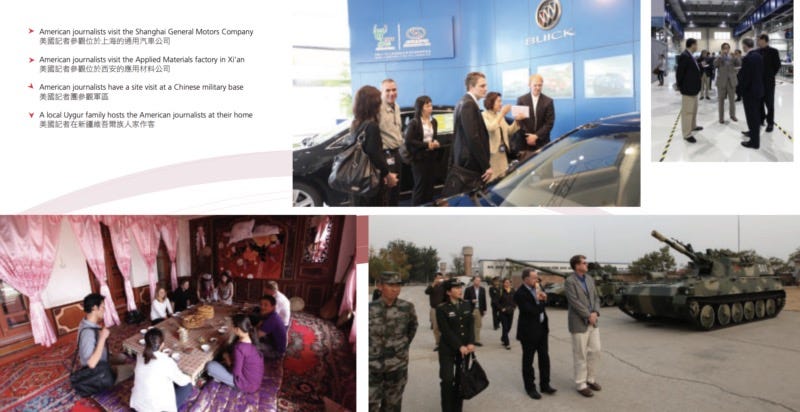
The identities of the journalists were not presented together in the filings. They emerge only after matching those records with CUSEF’s own publications and accounts from the trips.
The Names
Records identify the following journalists as participants in CUSEF-sponsored delegations, funded trips or related media exchange programs:
Ezra Klein, Vox co-founder and New York Times columnist;
Matthew Yglesias, Vox co-founder;
Ronald Brownstein, CNN senior political analyst and Atlantic senior editor;
Bradford Plumer, New York Times reporter;
Marjorie Miller, former Associated Press vice president and editor;
Steve Clemons, former editor-at-large of The Hill;
David Rohde, former New Yorker editor and current MS NOW national security reporter;
Jonathan Alter, MSNBC commentator;
David Sweeney, former NPR managing editor;
Daniel Gross, former Yahoo Finance columnist;
Marilyn Geewax, former NPR senior editor;
Kathleen Deveny, former Newsweek and Wall Street Journal Marketplace editor;
Tom Omestad, former U.S. News & World Report correspondent;
Steve Chapman, former Chicago Tribune columnist and editorial writer;
Bruce Stokes, former National Journal correspondent;
Craig Gilbert, former Milwaukee Journal Sentinel Washington bureau chief;
Tony Semerad, Salt Lake Tribune reporter;
Shikha Dalmia, former columnist for The Week;
Jonathan Broder, former Newsweek senior writer;
Cristi Kempf, former Chicago Tribune associate managing editor;
Jon Healey, Los Angeles Times deputy editorial page editor; and
Julian Pecquet, former Foreign Affairs reporter.
Washington Post columnist Catherine Rampell also disclosed that CUSEF funded one of her China trips, writing at the bottom of two columns:
“Disclosure: My trip is being paid for by the China-United States Exchange Foundation, a Hong Kong-based nonprofit that aims to improve Americans’ understanding of China.”
The disclosure acknowledged who paid for the travel. It did not tell readers that the organization’s foreign-agent representatives had discussed journalist trips in terms of favorable coverage and disseminating positive messages about Beijing.
The Coverage That Followed
Trip participant Shikha Dalmia published an op-ed titled “China Bashing is for Losers” during the same year she traveled to China.
Bradford Plumer later praised Beijing’s climate agenda in a piece titled “China’s ambitious plan to limit carbon emissions, explained.”
Bruce Stokes warned that economic “decoupling” from China would “backfire.”
Catherine Rampell repeatedly criticized the Trump administration’s China policies, including in a column titled “Team Trump should be careful what it wishes for on China.”
One of Rampell’s dispatches from her CUSEF-funded trip amplified complaints from Chinese officials who portrayed the United States as the aggressor attempting to contain China’s rise. The column repeated Beijing’s objections to American scrutiny of Huawei, criticism of currency manipulation and the Trans-Pacific Partnership before urging Washington to defuse the “zero-sum-game attitude” between the two countries.
David Rohde produced one of the starkest examples.
After participating in a CUSEF-organized trip, Rohde praised the role of the Chinese state in building and expanding businesses:
“Unlike the United States where free-market advocates deride the role of government, the Chinese state has played a central role in creating, supporting and expanding businesses here.”
He also defended the economic opportunities created by Beijing’s system:
“Those successes show that, for all the attacks from American politicians on Chinese currency manipulation, American companies can find profits in China.”
Rohde then argued that Americans should accept the permanent disappearance of large-scale domestic industry:
“Americans, meanwhile, should accept that large-scale manufacturing will never return to the United States.”
He concluded that American companies should profit from China’s rise while dismissing political objections in Washington as “ideological babble.”
Ezra Klein defended aspects of China’s response to COVID-19, writing on X:
“I keep hearing that China bought us some real time and our government wasted it doing nothing and downplaying the threat.”
Matthew Yglesias joked about helping Communist Party propagandists improve their messaging, writing that he wanted to “give Party flunkies notes” on how to better craft “propaganda.”
He separately quipped:
“Moody’s, S&P, and the People’s Bank of China should just run the government.”
At the time of his trip, Yglesias was affiliated with the Center for American Progress, whose alumni later filled numerous positions in the Biden administration.
Steve Chapman repeatedly attacked President Trump’s trade policies toward China, tweeting:
“China may have a bad human rights record, but you don’t have to take off your shoes for airport security.”
He also authored a now-deleted column making “the case for buying U.S. Olympic outfits from China.”
Ronald Brownstein opposed President Trump’s trade confrontation with Beijing and later attacked criticism of China’s handling of COVID-19.
Former NPR editor Marilyn Geewax went on to serve as a visiting professor at Tsinghua University, Xi Jinping’s alma mater and one of China’s most politically connected academic institutions.
All Roads Lead to Biden
The CUSEF network also intersected repeatedly with the political apparatus surrounding Joe Biden.
Bruce Stokes is the husband of Wendy Sherman, who became Biden’s deputy secretary of state and one of the administration’s most senior foreign-policy officials.
Steve Clemons enjoyed an especially warm relationship with Biden during the then-vice president’s 2013 trip to China.
Biden publicly introduced Clemons to Chinese Vice President Li Yuanchao as:
“A very important man.”
Biden then encouraged the Chinese official to speak with Clemons, declaring:
“He’s the one you really want to speak to.”
Later that day, while accompanied by Hunter Biden, the vice president jokingly attempted to buy Clemons an ice cream bar.
Clemons has since authored commentary arguing that “Biden gets China” and wrote approvingly about the emergence of “a new global order” with China serving as its “anchor.”
This Is What Foreign Influence Looks Like
The scandal is not simply that American journalists traveled to China.
It is that a CCP-linked organization quietly selected and cultivated influential members of the American press while its registered foreign agents discussed opportunities for “favorable coverage” and the dissemination of “positive messages.”
The public was shown the resulting articles.
It was not shown the influence operation behind them.
Beijing did not need to purchase an American newspaper or dictate every sentence. It could pay for access, curate the itinerary, arrange meetings with officials and allow trusted American voices to deliver the preferred conclusions.
Incredible reporting, as always. Tip of the spear at exposing IO campaigns here.
Natalie, thank you for continuing to pull back the curtain with this kind of rigorous investigative work. It is truly eye-opening to see these dynamics laid out so clearly. What troubles me most is how deeply the American public is being snowed by mainstream journalists who treat the news more like a PR machine than a public trust. They are acting as grifters—pushing self-serving narratives the exact same way figures like Al Sharpton have for years. We need more independent reporters willing to expose this. Keep knocking it out of the park!