
Strategy documents obtained by Natalie Winters reveal how an election network connected to former Obama official Norm Eisen coordinates anti-Trump messaging while its partners maintain direct contact with the officials who administer elections.
The memos were not intended for public consumption. One explicitly says it may not be shared outside the Election Safeguards Response Network, or ESRN, or with the press.
Inside are instructions to amplify election officials’ statements, portray federal intervention as interference, and avoid repeating claims about non-citizen voting—even to dispute them. One recommendation explains the communications calculation bluntly: “And when we fight feelings with facts, we lose.”
The April 20 document carries this restriction:
“It may not be shared outside of the ESRN and is not intended to be shared publicly or with the press.”

The network behind the memos
People’s Action identifies Eisen, Barack Obama’s former ethics official, as ESRN’s executive director. The Brennan Center says it plays a key role in the network.
ESRN calls itself nonpartisan. Its website invites nonprofit organizations into a coalition working across litigation, advocacy, communications, research, mobilization and organizing.
The restricted documents show how that coordination translates into public messaging. Both were accessible through Local Progress’s public resource page for elected officials, despite their distribution restrictions.
Contact with officials. A script for everyone else.
The April memo followed a Justice Department demand for Wayne County’s 2024 ballots and related records.
Michigan officials disputed its premise, saying the prosecutions demonstrated working safeguards and that allegations from a 2020 civil lawsuit had been rejected.
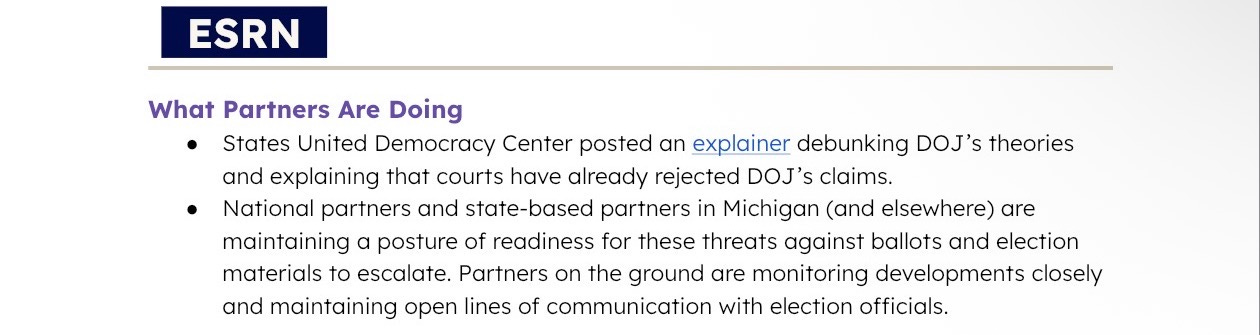
ESRN’s memo describes national and state partners preparing for escalation. It then identifies their connection to government:
“Partners on the ground are monitoring developments closely and maintaining open lines of communication with election officials.”
The next section, titled “What You Can Say,”points to messaging guidance and a social media toolkit. It says partners should amplify statements from Michigan’s statewide election officials and support local clerks and election workers.
It supplies the language:
“This is the latest attempt in a long line of desperate actions to interfere in Michigan’s elections.”
“Voters choose our leaders, not the other way around.”
Another suggested response begins: “Michigan’s local communities run our elections. Not the federal government.” A further script accuses the Trump administration of making election lies routine.
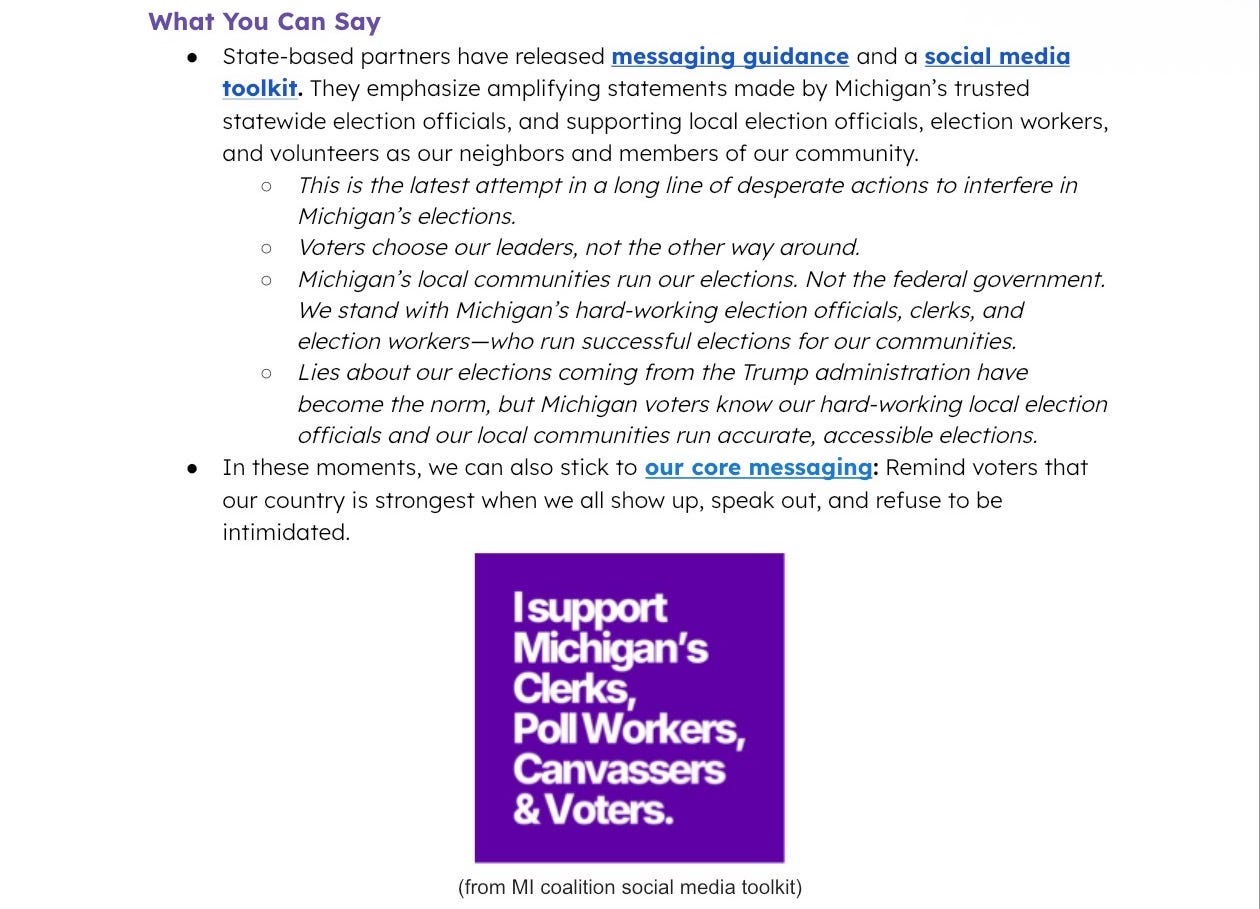
The arrangement is explicit: partners communicate with election officials, then receive guidance on amplifying officials’ statements and framing the dispute publicly.
“Resist the temptation” to list facts
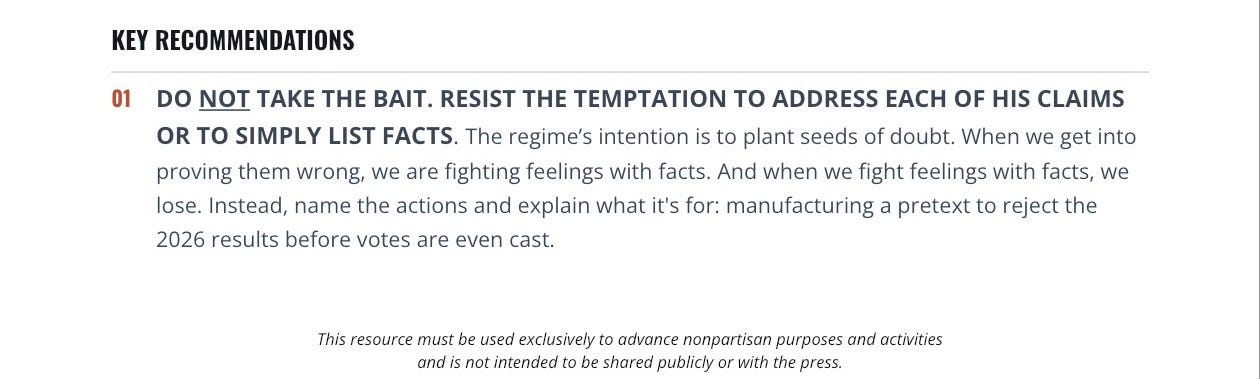
The July 16 memo develops the same approach into a response to Trump’s election allegations. Its first recommendation is emphatic:
“DO NOT TAKE THE BAIT. RESIST THE TEMPTATION TO ADDRESS EACH OF HIS CLAIMS OR TO SIMPLY LIST FACTS.”
It argues that fact-by-fact rebuttals pit facts against feelings, and instructs recipients to frame Trump’s statements as manufacturing a pretext to reject the 2026 results before votes are cast.
The next instructions narrow what allies should repeat:
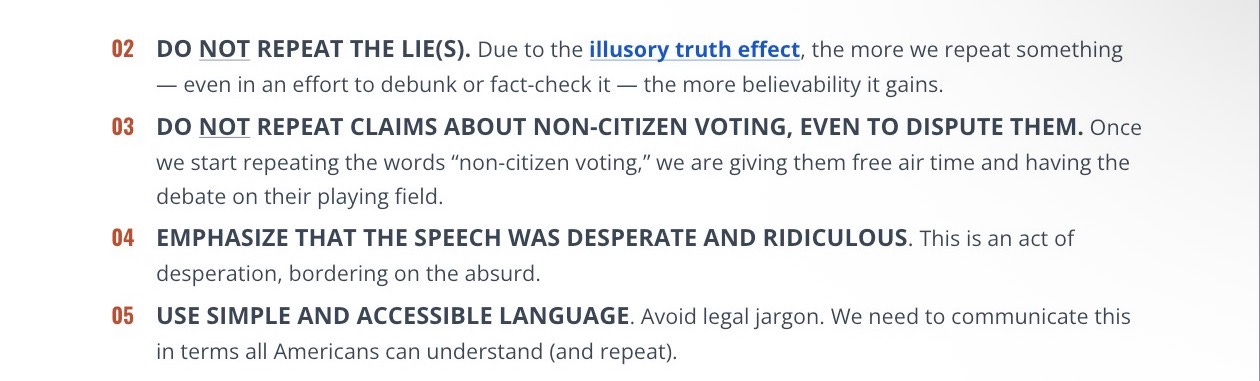
“DO NOT REPEAT CLAIMS ABOUT NON-CITIZEN VOTING, EVEN TO DISPUTE THEM.”
The stated rationale is that repetition can make false claims more believable and give the opposing argument free airtime. Recipients are instead instructed to “EMPHASIZE THAT THE SPEECH WAS DESPERATE AND RIDICULOUS.”
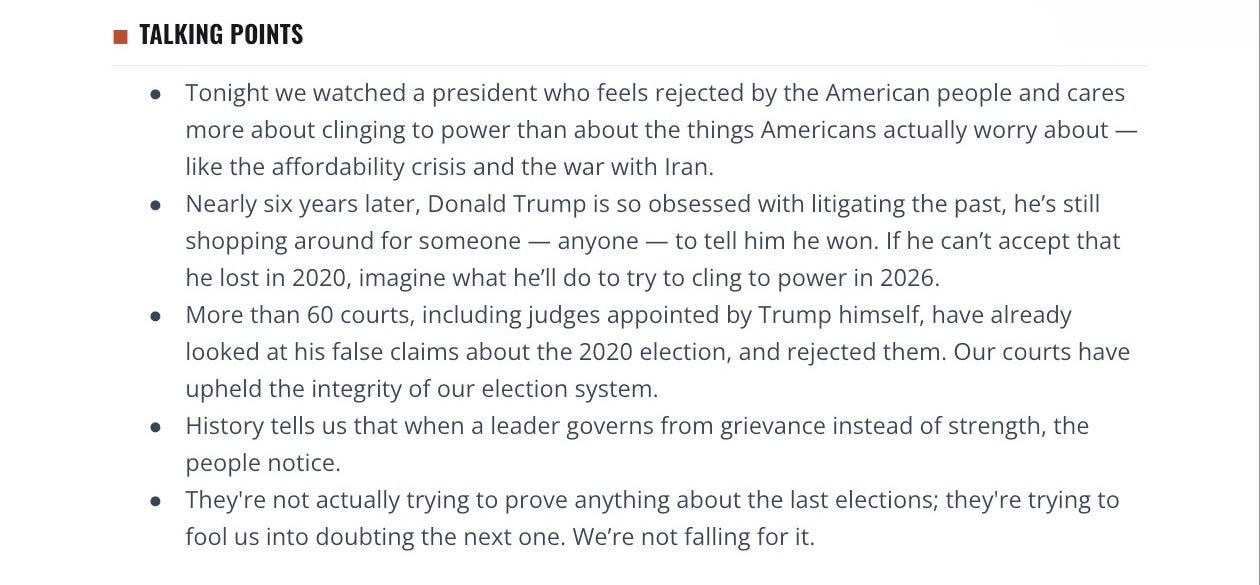
A separate “TALKING POINTS” section provides ready-made attacks. One portrays Trump as caring more about clinging to power than Americans’ concerns about affordability and the war with Iran.
Another turns the dispute over 2020 into a warning about the midterms:
“If he can’t accept that he lost in 2020, imagine what he’ll do to try to cling to power in 2026.”
The final script tells recipients:
“They’re not actually trying to prove anything about the last elections; they’re trying to fool us into doubting the next one. We’re not falling for it.”
Does any of this cause a democrat voter to change their vote? I think not as they have been conditioned to accept victory “by any means possible” including cheating!
Norm Eisen’s network should explain how its “nonpartisan” label squares with a restricted script telling allies to portray Trump as desperate and ridiculous. The line about losing when facts confront feelings is especially revealing. These are communications professionals calculating what the audience should hear, which questions deserve airtime, and whose statements should receive amplification. What truly deserves ridicule is dressing that operation in the robes of disinterested guardianship while expecting everyone outside the network to accept its framing. Contact with election officials makes transparency more important, not less. An echo chamber doesn’t become an independent authority because everybody inside it has a nonprofit logo.