
“We are collectively ready to enforce our election results if and as needed.”
That was Free DC executive director Keya Chatterjee’s pledge after Washington’s June primary. Now the anti-Trump organizing group is recruiting activists to rehearse election protests ahead of the midterms.
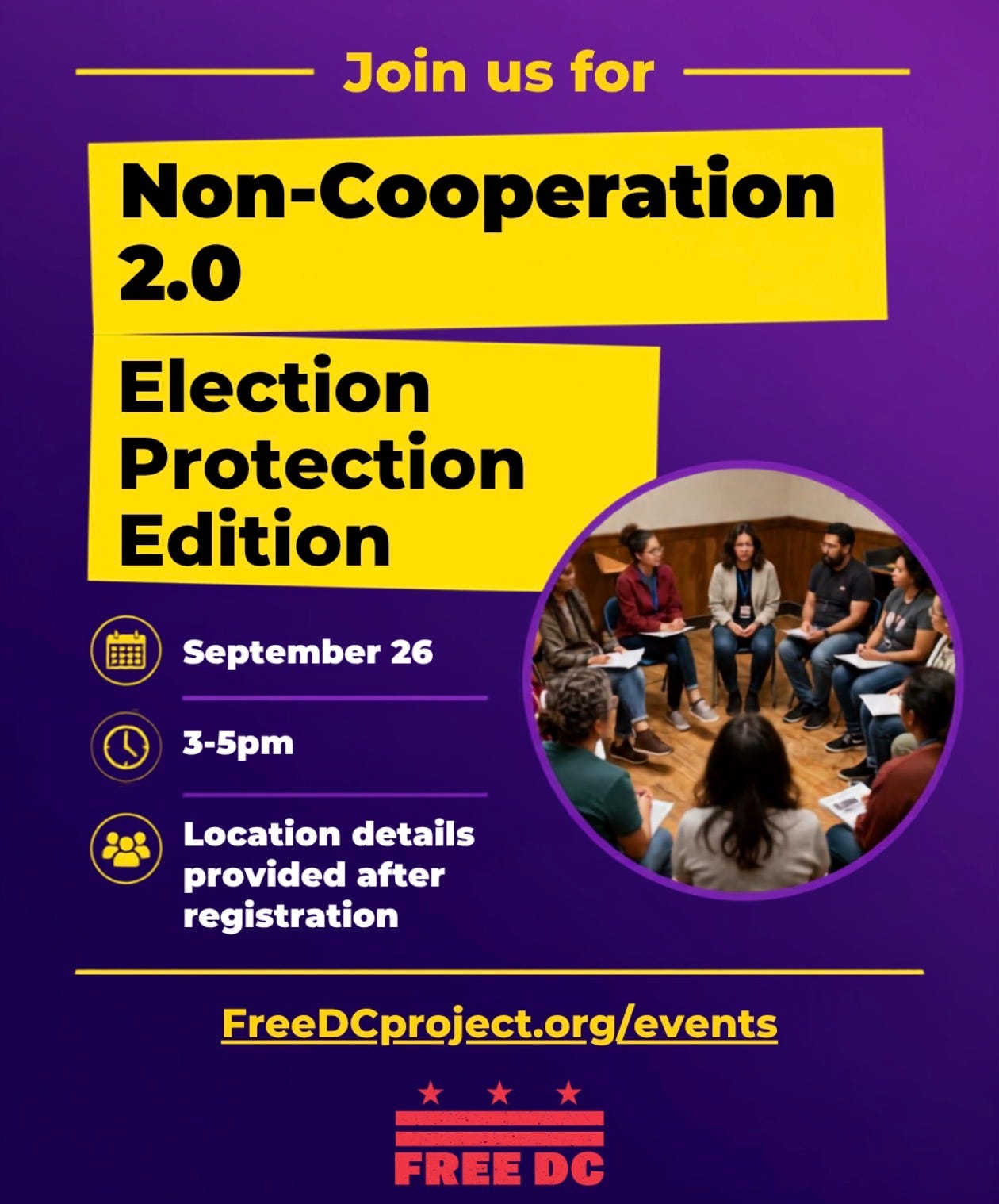
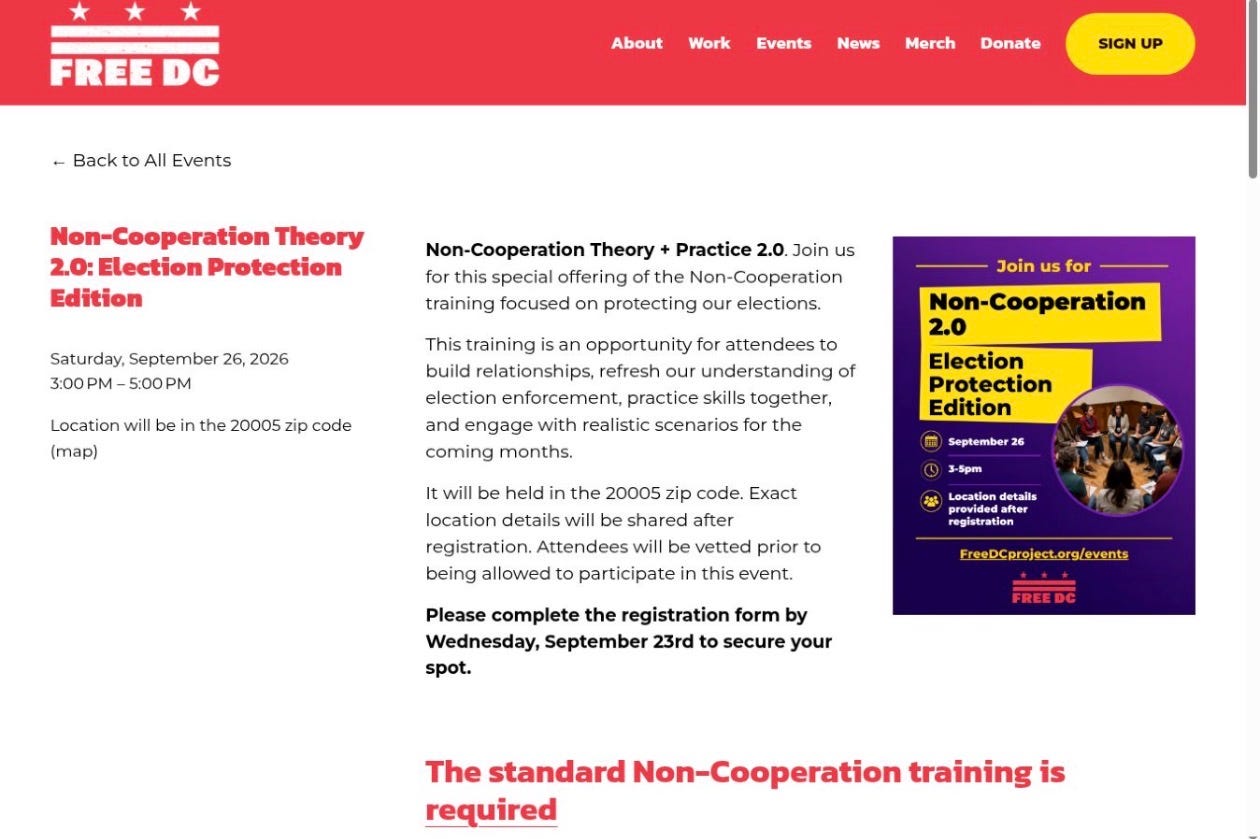
Its September 26 training promises to revisit “election enforcement” and includes:
“interactive role play of protest scenarios.”
The announcement follows preparations in which DC organizers developed a contingency for intersection blockades, a march to the Capitol and a coordinated withdrawal from work, school and shopping if primary results were seriously contested or tampered with.
Free DC has institutional backing for its organizing. Its fiscal hosts are Community Change and Community Change Action. Community Change’s disclosed supporters include Open Society Policy Center, Pivotal Ventures and Pritzker Family Foundation. On Free DC’s advisory council sits the head of an organization that has run political scenario exercises involving hundreds of groups.
Blockades were already on the table
The earlier election contingency laid out a sequence for taking the dispute into the streets.
Movement trainer Daniel Hunter, writing about DC’s June election preparations, described:
“morning intersection blockades, a midday march to the Capitol, evening gatherings”
The accompanying call:
“no work, no school, no shopping”
Organizers planned to revive tactics from their May Day demonstrations if the election went seriously wrong. Hunter described the contingency as nonviolent non-cooperation and reported that it was never activated. Organizers also prepared to explain why a slow ranked-choice count did not mean an election had been stolen.
Free DC was part of the DC Election Protection Coalition, led by the Lawyers’ Committee for Civil Rights Under Law. Its June statement describes more than 200 trained nonpartisan volunteers, an election hotline and a rapid-response command center staffed by legal volunteers.
The coalition said the primary went smoothly, with few reports of intimidation or other major problems. The contingency nevertheless shows that organizers had prepared to move beyond polling-place assistance to coordinated street and economic disruption if results faced serious interference.
The donors behind the sponsor
Free DC operates within a fiscal-sponsorship structure that gives projects an organizational home and supporting services.
Community Change’s 2024 donor disclosure names Open Society Policy Center, Pivotal Ventures, Pritzker Family Foundation, Ford Foundation, Omidyar Network Services LLC and Rockefeller Brothers Fund.
The organization also announced funding from Melinda French Gates’ Pivotal Ventures for its work advancing women’s power. It did not disclose its individual award amount.
Free DC’s leadership also includes a former Democratic political fundraiser. Council chair and co-founder Kelsye Adams previously served as finance director for Ralph Northam’s The Way Ahead PAC, according to her official biography.
War-gaming across hundreds of organizations
Another Free DC adviser, Connie Razza, runs Future Currents, an organization that helps movement groups practice responding to political crises and changing governing conditions.
Future Currents conducted 26 governing scenario exercises in 2024, bringing together more than 800 staff and board members from approximately 300 organizations. Participants imagined conditions in 2026 under alternative Democratic and Trump presidencies and worked through their responses.
The organization operates under New Venture Fund; Future Currents Action operates under Sixteen Thirty Fund. Its disclosed supporters include Ford Foundation and Rockefeller Brothers Fund, both also named in Community Change’s donor list.
Razza’s advisory position connects Free DC to that planning work, although the September announcement does not identify Future Currents as a training provider.
The upcoming class requires previous non-cooperation training and participant screening. Free DC says those requirements support a safe learning environment; the venue is disclosed after registration.
The actual scenarios and instructors remain unnamed, including whether activists will revisit the earlier blockade contingency.
Community Change, meanwhile, is already presenting Free DC’s organizing as a national example. Its 2025 annual report praises the project’s effort to:
“model community-rooted, nonviolent non-cooperation for the rest of the country.”
“Enforce our election results” is an extraordinary claim for a private political organization, especially when its contingency plans include shutting intersections and disrupting ordinary people’s lives. Citizens can demonstrate against misconduct, but a movement’s confidence in its own righteousness cannot give it authority over the count, the courts, or everyone trying to get to work. Free DC should explain what evidence would trigger its response, who would make that decision, and how disputed claims would be tested before disruption begins. Its institutional sponsors deserve the same scrutiny. Democracy cannot become a contest in which the best-funded organizers claim the streets and treat everyone else’s freedom as leverage.
Natalie your reporting is continually so amazing. Once again I hope you win the next Pulitzer Prize as the best journalist in the country. Keep up the great work.