
California Recruits Noncitizen Teenagers To Issue Ballots And Staff The 2026 Election
California does not want you looking too closely at who is helping run its elections.
Green card holders as young as 16 can check voters off official rosters, distribute ballots, handle election equipment, and help close polling locations. The state admits it does not fully track how many are being used.
They cannot legally vote in an American election. California is recruiting them to help administer one.
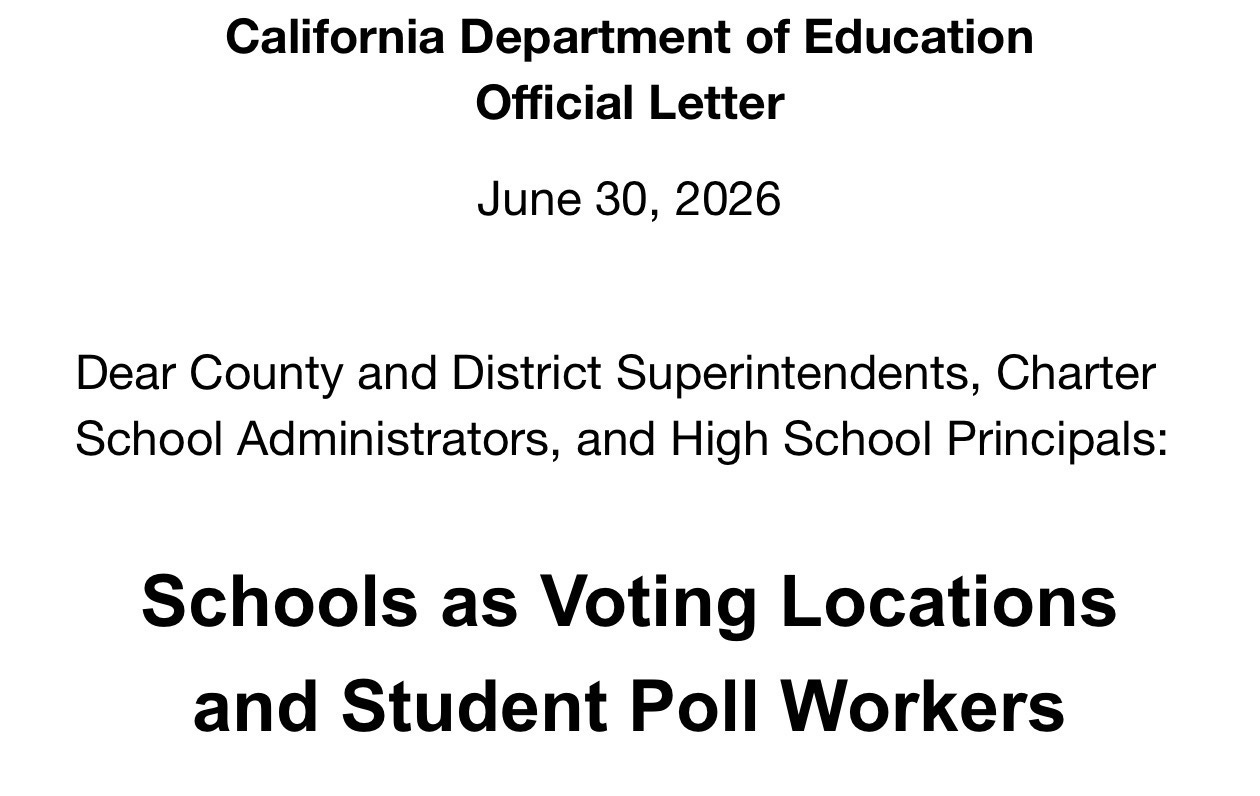
Documents reviewed by this publication reveal that California officials are directing public schools to identify teenagers as young as 16 to work inside polling locations during the November 2026 election, including lawful permanent residents who are not United States citizens.
These students are not being enlisted to hand out stickers or direct voters toward the entrance. County election agencies say they may issue ballots, check voters off official rosters, help operate election equipment, assist voters throughout the day, prepare ballots for pickup, and participate in closing polling locations.
In other words, California has made citizenship optional for the people performing frontline election duties.
The recruitment campaign appears in a June 30 letter signed by California Secretary of State Shirley Weber and State Superintendent Tony Thurmond and distributed to county superintendents, charter school administrators, and high school principals across the state.
The officials ask schools to provide their campuses as voting locations and encourage students to become poll workers for the November 3 general election.
“High school students who are at least 16 years of age, are U.S. citizens or legal permanent residents, and maintain a 2.5 grade point average are eligible to serve as poll workers,” the letter states.
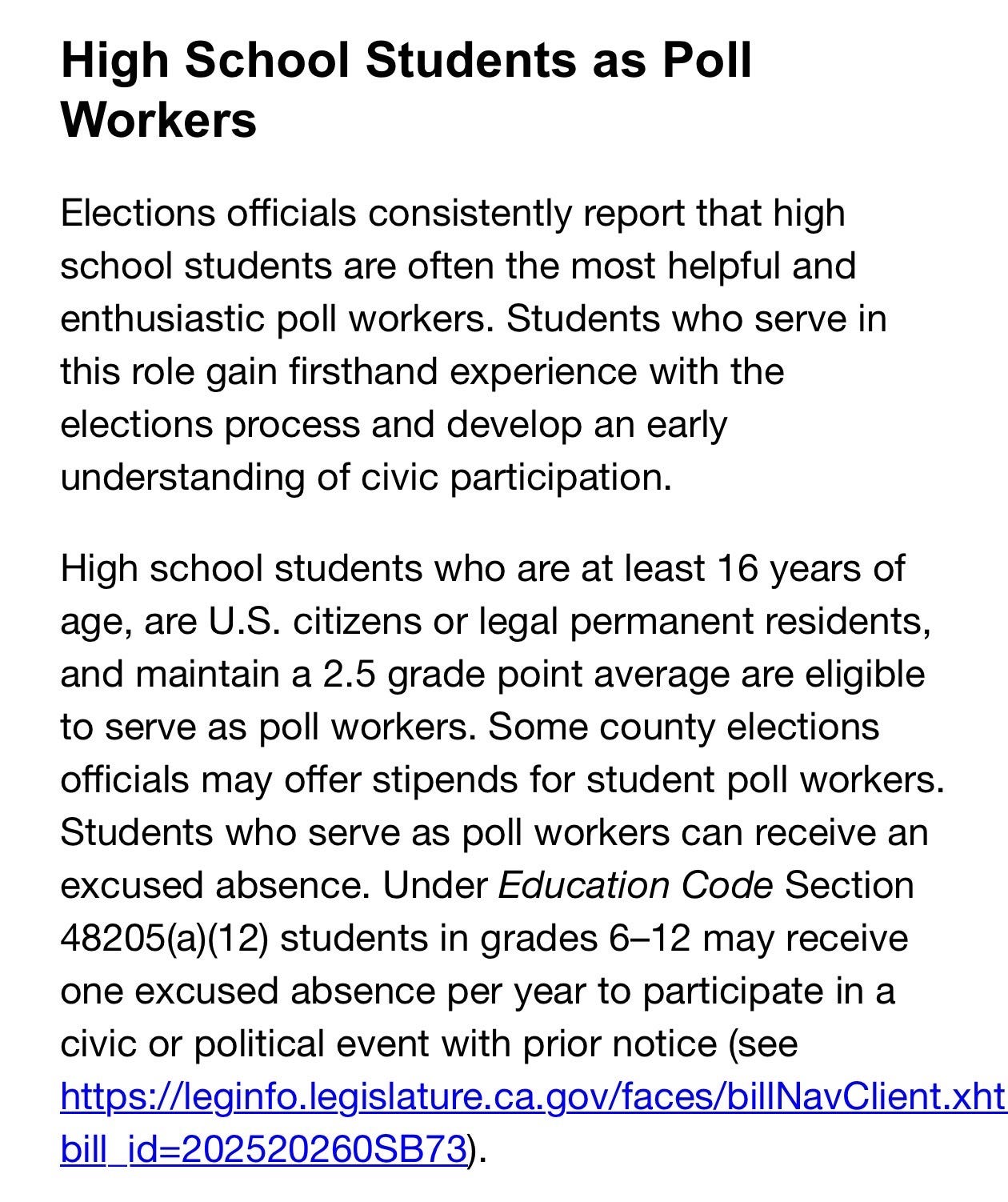
Weber and Thurmond urge school officials to “make every effort” to assist election agencies by identifying eligible students. The same letter encourages school districts to turn their campuses into vote centers, effectively transforming California’s public-school system into both election infrastructure and an election-worker recruitment pipeline.
The provision is embedded directly in California law.
Elections Code Section 12302 allows election officials to appoint up to five students per precinct even when those students lack eligibility to vote. Eligible students may be 16 years old and either American citizens, prospective citizens, or lawful permanent residents.
The law prohibits student workers from tallying votes. It does not limit them to ceremonial or peripheral jobs.
California law also separately authorizes adult noncitizens with green cards to serve as precinct-board members, provided that their only barrier to registering to vote is their lack of American citizenship. Those workers cannot serve as precinct inspectors or tally votes, but may otherwise participate in election administration.
County documents show exactly what that participation can entail.
Kern County says eligible student poll workers, including legal permanent residents, help set up voting equipment, open polling locations, issue ballots, check voters off in the roster, close the polls, and “count and prepare the ballots to be picked up.”
Riverside County states even more plainly that student workers “perform the same tasks of adult Pollworkers.” They help set up voting equipment, complete election paperwork, prepare ballot cartridges for transportation, store election equipment, and secure the polling location after voting ends.
Los Angeles County openly advertises the program to “Legal Permanent Resident” students, adding “Green Card Holder” in parentheses to eliminate any possible ambiguity.
Those students assist with opening and closing vote centers and helping voters throughout the day. They receive $100 for each day worked, $80 for election training, and an additional $100 bilingual bonus.
For the June 2026 primary, Los Angeles offered participating teenagers as much as $480 for a three-day assignment. The county required students to work from 6 a.m. until 9 p.m. on Election Day after completing both online and in-person election training.
California is not merely permitting this arrangement. It is actively working to expand it.
The Secretary of State’s report on the November 2024 election says counties recruited 1,095 lawful permanent residents and 2,978 bilingual students to serve as poll workers.
Los Angeles County alone reported 610 lawful permanent residents and 1,327 bilingual student poll workers. The two categories are listed separately, and the state does not disclose how many of the student workers were also noncitizens.
That missing information is not a minor detail.
The Secretary of State admits that many counties do not collect adequate data on lawful permanent residents and students serving in elections, making it difficult to determine the full scale of the program or analyze who is actually working inside polling locations.
California’s response to this lack of transparency is not to pause the practice. It is to recruit more.
The report “strongly encourages” counties to develop “innovative strategies” to recruit lawful permanent residents and bilingual students. It recommends expanding partnerships with schools, colleges, nonprofits, advocacy organizations, and bilingual education programs to enlarge the election-worker pool.
The policy was not created accidentally. It was assembled in stages with support from the progressive election and immigration advocacy apparatus.
In 2013, Assembly Bill 817 authorized California election officials to appoint lawful permanent residents as precinct-board members, despite their ineligibility to register to vote because they were not citizens.
Two years later, lawmakers passed Assembly Bill 554 to extend the same policy to noncitizen high school students.
The official legislative analysis described the exclusion of teenage lawful permanent residents from polling operations as an “oversight” that needed to be corrected. The analysis argued that placing noncitizen students inside American polling locations would allow them to “experience American democracy firsthand,” potentially encouraging them to become naturalized voters later.
The expansion was supported by California Common Cause, the League of Women Voters of California, the California Immigrant Policy Center, Asian Americans Advancing Justice, the National Association of Latino Elected and Appointed Officials Educational Fund, and several other immigration advocacy organizations.
The legislative file records no formal opposition.
California officials justify the program as a way to find bilingual workers capable of assisting citizens with limited English proficiency. Lawful permanent residents are legal immigrants, and the documents reviewed provide no evidence that these workers are themselves casting ballots or illegally tallying votes.
But that defense evades the central issue.
Citizenship is the foundational qualification for participating in the selection of America’s government. California has decided it should not be a foundational qualification for administering that selection.
A 16-year-old noncitizen cannot cast a ballot for governor, Congress, or president. Yet California allows that same teenager to check citizens against an official voter roster, place ballots into their hands, assist them inside a vote center, handle election equipment, and help secure the polling site when voting ends.
The state is now using public schools to recruit more of them, paying them hundreds of dollars, and urging advocacy groups and nonprofit organizations to enlarge the program, all while conceding that it does not possess complete data showing how many noncitizens are already embedded in election operations.
California’s message could not be clearer: citizenship is mandatory for the voter, but increasingly optional for the system surrounding the vote.